
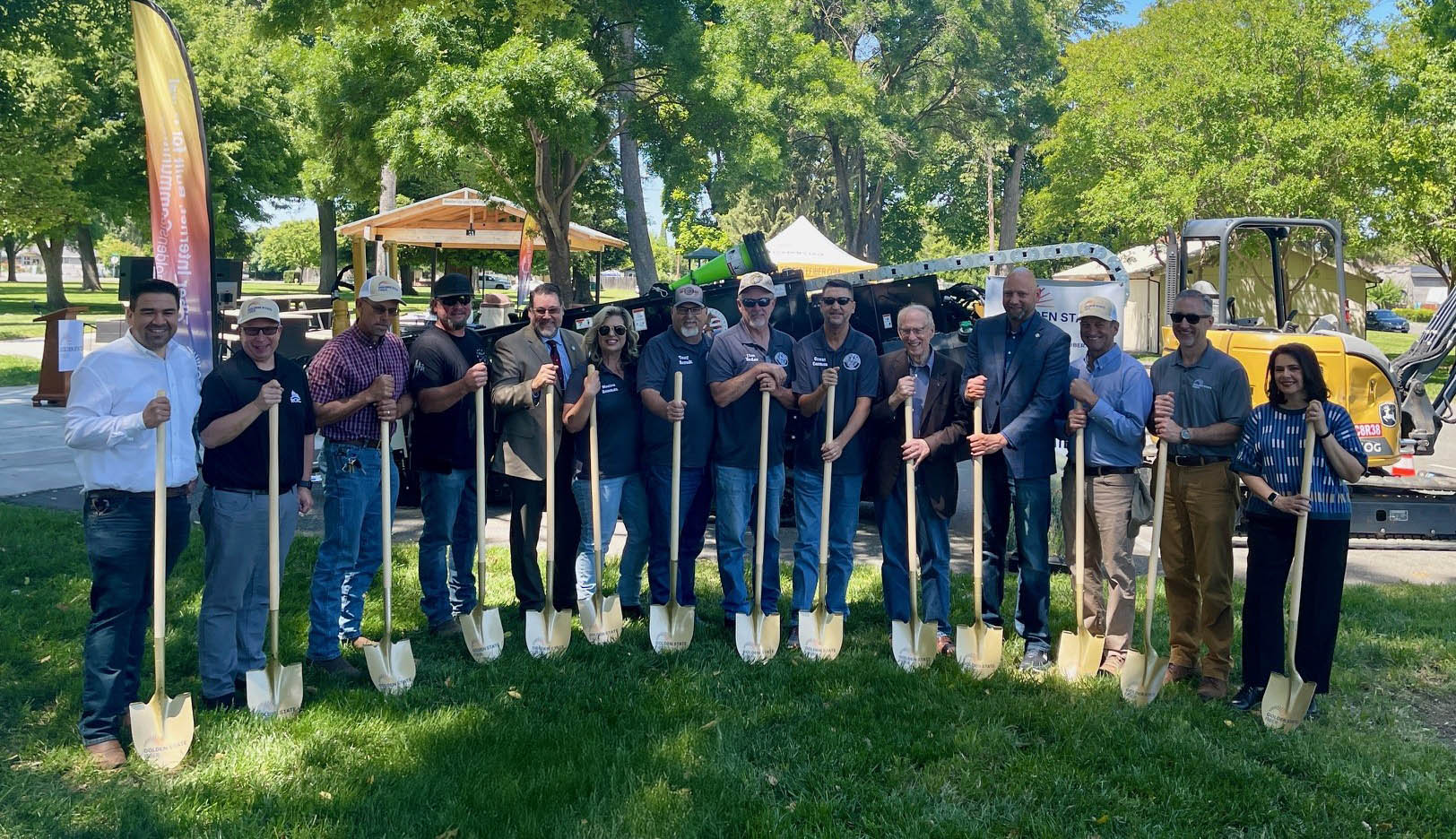
On Thursday, the Golden State Connect Authority (GSCA), an affiliate entity of RCRC, broke ground on the Golden State Fiber network in Glenn County, launching construction on a major rural broadband project and the first deployment in a multi-county effort to expand last-mile connectivity across rural California. State and local leaders gathered at Hamilton City Park to commemorate the occasion, a significant step toward closing the digital divide in underserved communities.
This groundbreaking marks the first of seven planned fiber deployments in Alpine, Amador, Glenn, Imperial, Mono, and Tehama counties, as well as the Town of Mammoth Lakes. Backed by $110.9 million in bond financing and $185.4 million from the California Public Utilities Commission’s Last Mile Federal Funding Account, the Golden State Fiber network will deliver open-access, high-speed fiber infrastructure to communities that have historically lacked reliable and affordable internet service.
In Glenn County, construction will begin on June 10, 2026, and proceed in two phases, reaching a total of 2,445 homes, including 1,575 in the first phase. Across the initial seven project areas, the network will span 1,065 miles of fiber, with the first 40 miles constructed in Glenn County.
California state and county officials who spoke at the groundbreaking included Brian Dahle, former California State Senator; Chris Lopez, Chair, Golden State Connect Authority and Monterey County Supervisor; David Griffith, Vice Chair, Golden State Connect Authority and Alpine County Supervisor; Maria Ellis, CPUC Director for Broadband Initiatives; and Monica Rossman, Glenn County Supervisor.
Remarks were also delivered by project partners, including Roger Timmerman of UTOPIA Fiber, the network’s operational partner, and John Lucas, Regional Director of HP Communications, Inc., the Glenn County project’s construction partner.
Golden State Fiber will operate as a publicly owned, open-access network that Golden State Connect Authority will finance, construct, own, operate, and maintain. The model allows multiple private sector internet service providers to compete on the same infrastructure, increasing customer choice and affordability for rural communities.
See the full press release here and learn more about the Golden State Fiber network here